
Verified answer
Quick answer
The clearest strengths across reviewed coverage are the dark narrative, memorable characters, world building, and reactive choices. The largest tradeoffs are divisive directional combat and technical roughness reported on PS5 Pro and Xbox Series X.
Update 1.1 is released on PC, PS5 and Xbox Series X|S. Consider playing for story and reactivity, but check the RX 9070 XT warning and evidence for any exact performance, reset or NG+ requirement before deciding.
Evidence checked October 22, 2026. All-platform 1.1 release notes checked. This remains a launch-review synthesis, not a new hands-on review or benchmark.
Turn the launch verdict into a practical plan with the Steam & PC Guide, PS5 Guide, Patch Notes, New Game Plus Status, Respec & Draught of Mind Rebirth, Story vs Forgiving Difficulty, Beginner Tips and Quests & Quest Order.
Should you play now after the PS5 1.1 release?
Update 1.1 is released on PC, PS5 and Xbox Series X|S, confirmed in the official October 22 notes. This is not a new hands-on review or benchmark, nor proof that every launch criticism is resolved.
Consider playing now for reactive quests, characters and dark-fantasy atmosphere; 1.1 also documents respec and a more assisted Story mode. Wait for more specific evidence if your purchase depends on exact reset rules, NG+ or a measured performance threshold. This remains an editorial synthesis of published reviews and release notes, not our own new playthrough.
The full notes now replace the preview as the current feature source. They document named quest and crash fixes, but also retain a known RX 9070 XT FrameGen-toggle crash. Check the PC guide if that is your GPU, and match any console performance evidence to your model and mode. Patch status is not a universal bug-free verdict.
| Your priority | Practical recommendation | Evidence to check |
|---|---|---|
| Story, atmosphere, and consequential quests | The launch-review synthesis gives reasons to play if you accept combat and polish tradeoffs. | Watch current gameplay and compare the review scope below with your preferences. |
| PC stutter or a firm frame-rate requirement | Do not buy on the assumption that announced FrameGen changes solve every cause. | Use the PC checklist and a released-build test on similar hardware. |
| PS5 / PS5 Pro stability | Wait for same-model, same-mode measurements if stability is non-negotiable. | Verify patch, graphics mode, display, scene, and frame pacing rather than an FPS target. |
| Respec or assisted Story mode | These are documented 1.1 features; check the installed version and any rule essential to your run. | The full notes confirm release, not an acquisition walkthrough or trophy eligibility. |
| A carryover second campaign | Keep your completed save; do not treat respec as NG+. | Look for an explicit NG+ release and carryover rules, which this source set does not verify. |
For platform-specific checks, use the Steam and PC guide, PS5 guide, and New Game Plus status. No new benchmark, review score, or universal “bug-free” verdict is inferred from player comments.
Review scope
This page synthesizes published launch reviews; it is not a claim that this site completed a separate full playthrough. The source conditions are uneven: PC Gamer reported 35 hours on a Windows laptop, TechRadar described about 25 hours on PS5 Pro without finishing, GamesRadar+ reached an ending after 26 hours on PC and continued to 31, and Tom's Guide reviewed Xbox Series X. Exact build numbers were not consistently disclosed, and the sources below do not provide an independent Series S review sample.
What the cited reviewers played
| Publication | Platform and scope | Overall position |
|---|---|---|
| PC Gamer | PC; 35 hours; RTX 3060 laptop, Ryzen 5 5600H, 16 GB RAM | Strong horror atmosphere, world, combat, and consequence system; several ideas do not reach their full potential |
| GamesRadar+ | PC; first ending at 26 hours, 31 hours total | Respects the freedom and supernatural tool set, but finds repetitive activities and the time economy discouraging |
| TechRadar | PS5 Pro; about 25 hours; review not completed | Praises writing, voice acting, and selected quests; criticizes repetitive tasks, combat, and underused systems |
| Tom's Guide | Xbox Series X | Calls it a rough but compelling debut, with excellent storytelling offset by combat and technical problems |
| Creative Bloq | PS5 review | Praises reactivity and stranger vampire material; criticizes ordinary open-world structure and shallow progression |
Because these reviewers used different platforms and did not all finish the same route, their observations are a cross-platform launch snapshot, not a controlled benchmark.
Story and world
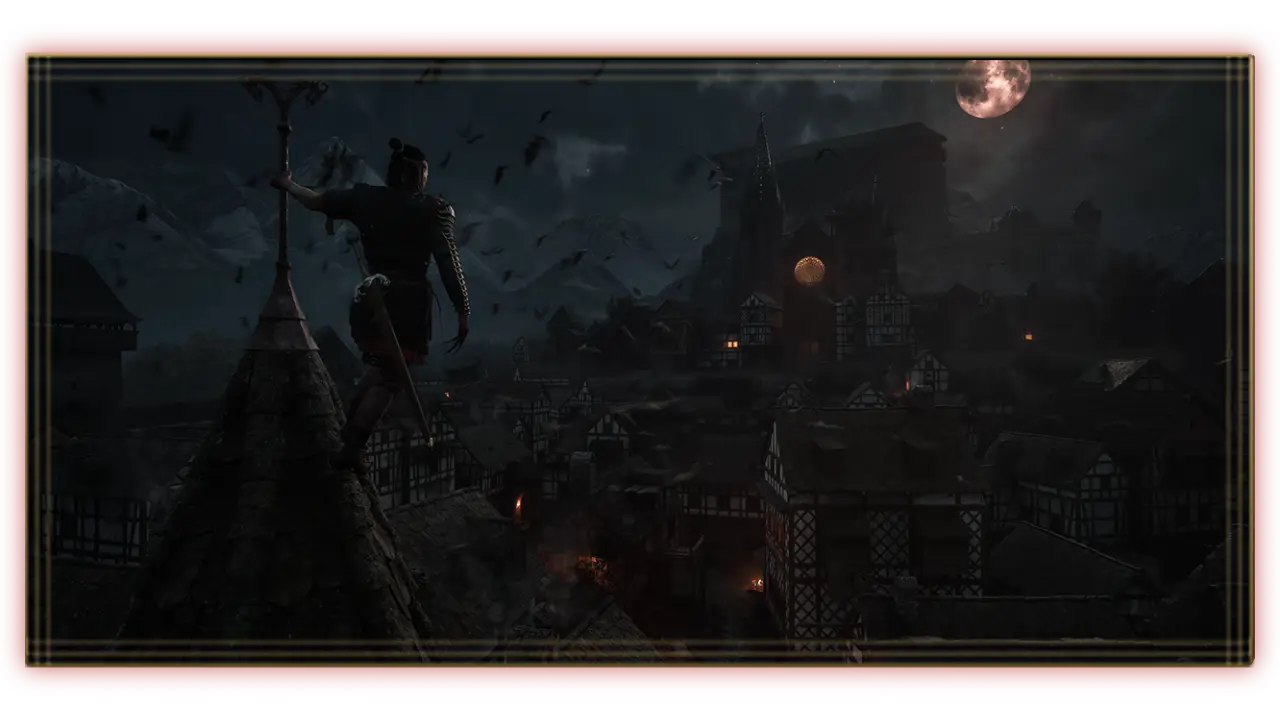
The strongest point of agreement is the dark-fantasy narrative. PC Gamer emphasizes the relentlessly bleak horror tone and the moral uncertainty of its quests. TechRadar and Tom's Guide both praise the characters and dialogue, while Creative Bloq highlights the moments where the vampire mythology pushes beyond a familiar medieval setting. Across the reviews, Vale Sangora's strongest asset is not map size but its atmosphere and the feeling that personal decisions can return later.
Coen's day/night identity supports both the fiction and the route structure. Human Coen relies on swordplay, conversations, and Witchcraft, while vampire Coen gains claws and supernatural traversal. Reviewers are more positive when this duality shapes quests and imagery than when it functions as a simple change of tools.
Quest design and choice
Companion chains, investigations, and faction decisions are the clearest match for players who enjoy consequence-driven RPGs. PC Gamer reports seeing three endings and describes allegiance shifting as the story forces choices between competing harms. Creative Bloq gives a more cautious version of the same point: even small actions can create doubt about what will return later. Meaningful reactivity is the clearest point of critical agreement, although no source claims that every dialogue line creates a separate campaign.
The 30-day framework asks players to decide which objectives deserve time rather than clear every marker without friction. That structure can create pressure for completion-focused players, but free exploration does not normally consume time, making scouting safer than the premise first suggests.
The reviewers disagree about how successfully the calendar maintains urgency. PC Gamer finds it valuable because it changes how quests are planned, but also reports reaching the later game with ample time. GamesRadar+ argues that visible time costs make many routine activities feel like poor value. TechRadar similarly considers the timer and day/night loop underused. The fair conclusion is that the system changes decision-making even when it does not create constant pressure.
Combat tradeoffs
Directional combat is the most divisive element in the coverage. PC Gamer enjoyed the fights and the dueling rhythm, while TechRadar calls combat serviceable but dull. Tom's Guide finds the directional core satisfying when it works but criticizes movement, camera behavior, and repetition. Creative Bloq also argues that sword combat can feel more satisfying than the vampire claws, an awkward tradeoff for the central fantasy.
The safest buying approach is to watch current, unedited combat footage and inspect four situations: one-on-one directional blocking, crowded encounters, lock-on behavior, and nighttime claw combat. The game offers difficulty and blocking adjustments, but a setting change cannot guarantee that the combat feel will suit every player.
Progression and open-world structure
The three progression paths—Swordmastery, Witchcraft, and Vampirism—give Coen different day and night tools. Critical response is split on whether those choices produce distinct builds. GamesRadar+ found Swordmastery broadly useful in both forms but questioned the value of repeating the game for another build. Creative Bloq felt specialization was weakened by the volume of upgrade points. Separate build coverage shows that focused perk loops do exist around Perfect Blocks, Witchcraft control, and blood recovery.
The open world draws a similar split. Reviewers consistently praise the visual identity of forests, settlements, ruins, and supernatural spaces, but several criticize repeated camps, loot, and combat-heavy activities. Players who follow character chains and major investigations are more likely to see the material reviewers praised than players attempting to clear every marker.
Performance and polish
PS5 Pro and Xbox Series X coverage reported technical roughness at launch. Tom's Guide describes texture loading, frame-pacing issues, visual bugs, and a traversal incident on Xbox Series X. TechRadar's PS5 Pro review used Balanced mode, which targets 40 fps, and notes the hardware and display used. Official console modes target 60, 40, and 30 fps, but targets are not guarantees, and the cited reviews do not provide controlled patch-by-patch testing.
PC performance depends on hardware and settings. PC Gamer discloses its RTX 3060 laptop, Ryzen 5 5600H, and 16 GB RAM, but one system cannot establish universal performance. GamesRadar+ also reviewed on PC yet focused more on design than benchmark data.
The original September 9 review synthesis used PC 1.0.3 and console 1.0.2 context. The site's later historical records cover PC Hotfix 1.0.5 and console Hotfix 1.0.4; the October 22 full notes confirm the all-platform 1.1 release. None of those documents is a new controlled performance comparison. Use the PC and PS5 checks before treating launch-week observations—or a released fix list—as the current measured result.
Who should play it?
The Blood of Dawnwalker is the stronger fit if you prioritize:
- Dark, character-driven fantasy and horror
- Reactive quests and visible consequences
- Planning around day, night, and limited story time
- A hybrid human/vampire tool set
- A dense world where major character routes matter more than clearing every icon
Consider waiting or researching further if you need:
- Highly polished launch performance
- Fast, fluid action combat with little input friction
- A completion structure without meaningful time commitments
- Strong evidence for Series S-specific performance
- A completely distinct activity behind every open-world marker
Verdict without a fabricated score
The evidence supports a conditional recommendation. Its narrative, characters, atmosphere, and reactive quest structure are the reasons to play; combat feel, repetitive activities, and technical polish are the reasons to verify before buying. A numeric score would imply an original standardized review process this site did not perform, so none is invented.
If your priority is a bleak, choice-driven RPG and you can tolerate rough edges, the review consensus leans positive. If your priority is refined action combat, seamless performance, or clearing every activity without weighing time costs, the same sources give strong reasons to wait for more patches or watch platform-specific gameplay first.
Sources
- Rebel Wolves — official Update 1.1 preview, October 16
- Official game overview
- Official launch announcement
- PC Gamer review — PC, 35 hours
- GamesRadar+ review — PC, 31 hours
- TechRadar review — PS5 Pro, about 25 hours
- Tom's Guide review — Xbox Series X
- Creative Bloq review — PS5